
Classic Surveying Equipment - دانشکده مهندسی نقشه برداری و اطلاعات مکانی geospatialeng
Classic Surveying Equipment
Introduction to the Planicart E3
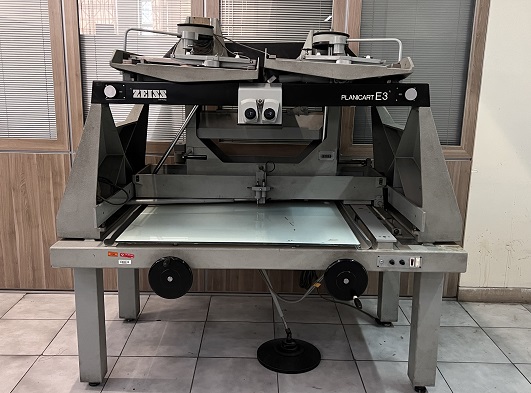
The Planicart E3 is an analogue (mechanical) photogrammetric instrument manufactured by Carl Zeiss in Oberkochen, Germany, and developed in the 1970s. It is essentially a mechanical stereo plotter designed to extract geometric information from pairs of aerial photographs (stereoscopic models) and to compile maps.
Technical Specifications and Performance
- Optical System and Magnification: The stereoscopic viewing magnification is 6×. Image/model magnification reaches up to 3.5× for wide-angle (WW) and super-wide-angle (ÜVW) photographs, and up to 2.2× for narrow-angle (NW) photographs.
- Measurement Accuracy: The stated planimetric accuracy of the instrument is ±6 micrometres, and its elevation accuracy is ±0.039‰ of the flying height.
- Internal Plotting Table: It features an internal plotting table with an illuminated surface. There is also the possibility of connecting an external plotting table with adjustable magnification ranging from 1:0.5 to 1:8.
Digital Capabilities and Connections
Although the Planicart E3 is an analogue instrument, it was also adapted for use in semi-digital environments:
- Conversion to Digital Output: I
n many mapping centres, the instrument was equipped with linear encoders (for the X and Y axes) and a rotary encoder (for the Z axis) to enable the digital transfer of coordinates to a computer.
- Connection to Computers and Digital Tables:
The instrument could be connected to minicomputers (such as the HP 1000) and digital plotting tables (such as the DZ 7). Moreover, in 1982, one unit was linked to an INTERGRAPH graphics workstation.
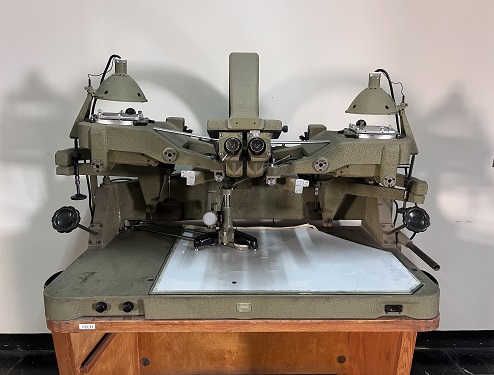
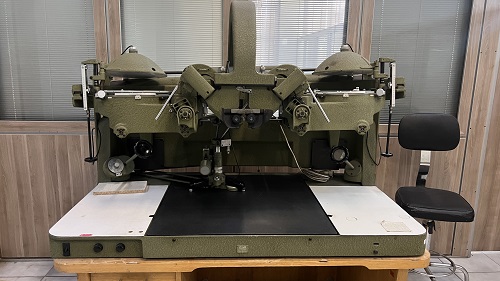
Durst D659 Duomat Super Color Device:
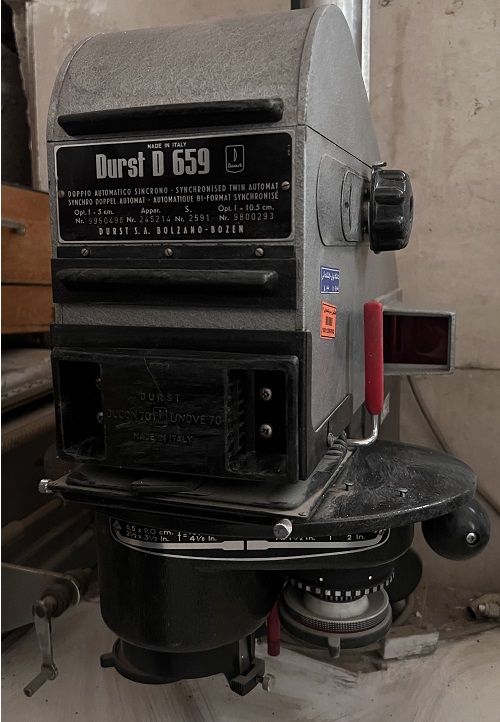
The Durst D 659 is a professional analogue photographic enlarger, not a photogrammetric instrument. It was originally designed for enlarging photographic negatives and printing images onto light-sensitive paper, and was manufactured in the mid-twentieth century (approximately 1946 to 1967) by the Italian company Durst.
Technical and Structural Specifications:
This device was heavy and durable equipment intended for professional photographic laboratories, and it had the following features:
- Dimensions and Material: It stood approximately 110 centimetres tall, and its body was constructed from a combination of metal, glass, and a wooden base.
- Light Source: It used a 100 to 200-watt lamp for exposure and was equipped with a detachable condenser lens (light concentrator).
- Autofocus System: One of the distinguishing features of this model was its mechanical autofocus system. This meant that after the initial focus was set, the focus was maintained when the height of the device was adjusted for greater or lesser magnification. However, this capability usually functioned correctly only with the original, calibrated lenses supplied with the device (typically Schneider Componar lenses).
Performance and Lenses
This device was designed to accommodate various negative formats and was usually equipped with a rotating turret holding two lenses:
- 105 mm Lens: Used for larger negatives (up to 6×9 cm), providing magnification of approximately 1.4× to 7×.
- 50 mm Lens: Used for smaller negatives (such as 24×36 mm), enabling magnification of 2.3× to 16×.
Important Note on Its Application
Although this device is fundamentally a photographic instrument, in some academic and engineering sources (such as the School of Surveying and Geospatial Engineering), Durst enlargers have been used for plotting and enlarging satellite or aerial imagery onto plotting tables (such as Zeiss Planicart tables). In other words, the device was employed as a precise optical projector to transfer images onto a mapping surface. Therefore, although it is not a photogrammetric instrument, it has been used in auxiliary processes of traditional mapping.